20 Best Things to See in park Güell
What to Do in Park Güell? Best Things to See, Hidden Details & Visitor Guide
If you are wondering what to do in Park Güell, do not plan your visit around the famous dragon alone. The monumental area contains a carefully connected sequence of stairways, columns, fountains, mosaics, terraces and stone structures, while the wider park adds viaducts, gardens, paths, houses and viewpoints.
What makes Park Güell particularly interesting is that many of its features were designed to work together. The staircase connects to the Hypostyle Room, the square above it is linked to a rainwater collection system, and the viaducts were designed to make movement through the steep terrain possible.
So instead of simply collecting photographs of the famous spots, look at how the different parts of Park Güell fit together. This guide explains what to do in Park Güell, what to see first, which details many visitors miss and how to make the most of your time.
What to Do in Park Güell: Quick Answer
The main things to see and do inside Park Güell include:
- Walk through the entrance and Porter’s Lodge pavilions
- Look at the original entrance gates
- Walk up the Dragon Stairway
- See El Drac, the famous mosaic salamander
- Look at the smaller sculptural and decorative details
- Explore the Hypostyle Room
- Examine the Doric-inspired columns and mosaic ceiling
- Understand the rainwater collection system
- Walk onto La Plaça de la Natura, also called the Greek Theatre
- Sit on the serpentine mosaic bench
- Look at the drainage details built into the terrace
- Enjoy the Barcelona views
- Walk through the Laundry Room Portico and see the Washerwoman figure
- Explore the Low, Middle and High Viaducts
- Walk along the roads and paths
- Visit the Austria Gardens
- See Larrard House and Trias House from outside
- Visit the Gaudí House Museum if you have access
- Walk the Palm Trees Path
- Explore the Biodiversity Itinerary
- Climb toward the Three Crosses
- Look for the relationship between architecture, vegetation and the natural terrain
- Photograph the smaller details rather than only the famous dragon
The best experience comes from taking your time rather than treating Park Güell as a checklist of photographs. If you are deciding what to do in Park Güell, begin with the central monumental area and then continue into the wider landscape.
1. Start at the Entrance and Porter’s Lodge Pavilions
Before you even reach the famous staircase, stop at the main entrance on Carrer d’Olot.
The entrance is framed by two distinctive buildings known as the Porter’s Lodge pavilions. One served as the porter’s lodge, while the other was the visitors’ waiting room and porter’s residence. Their unusual forms and colorful trencadís roofs immediately introduce the architectural language of Park Güell.
The entrance was not simply designed as a practical gateway. Its buildings, wall, gates and decorative details were intended to form part of the overall experience.
The official Park Güell material identifies the two entrance pavilions as important features of the park, while its visitor map also identifies them as part of the main monumental sequence.
Look at the Gates
The iron gates have a distinctive palm-leaf design.
One interesting detail is that the gates were not originally designed specifically for Park Güell. They came from Casa Vicens, another important Gaudí building.
That is an easy detail to miss if you immediately head toward the Dragon Stairway.
Take a moment to look at the combination of:
- Rough stone
- Ceramic decoration
- Organic shapes
- Ironwork
- Trencadís
- The surrounding vegetation
The entrance gives you an early example of how Gaudí combined architecture and natural forms rather than treating the building and landscape as completely separate elements.
2. Walk the Dragon Stairway
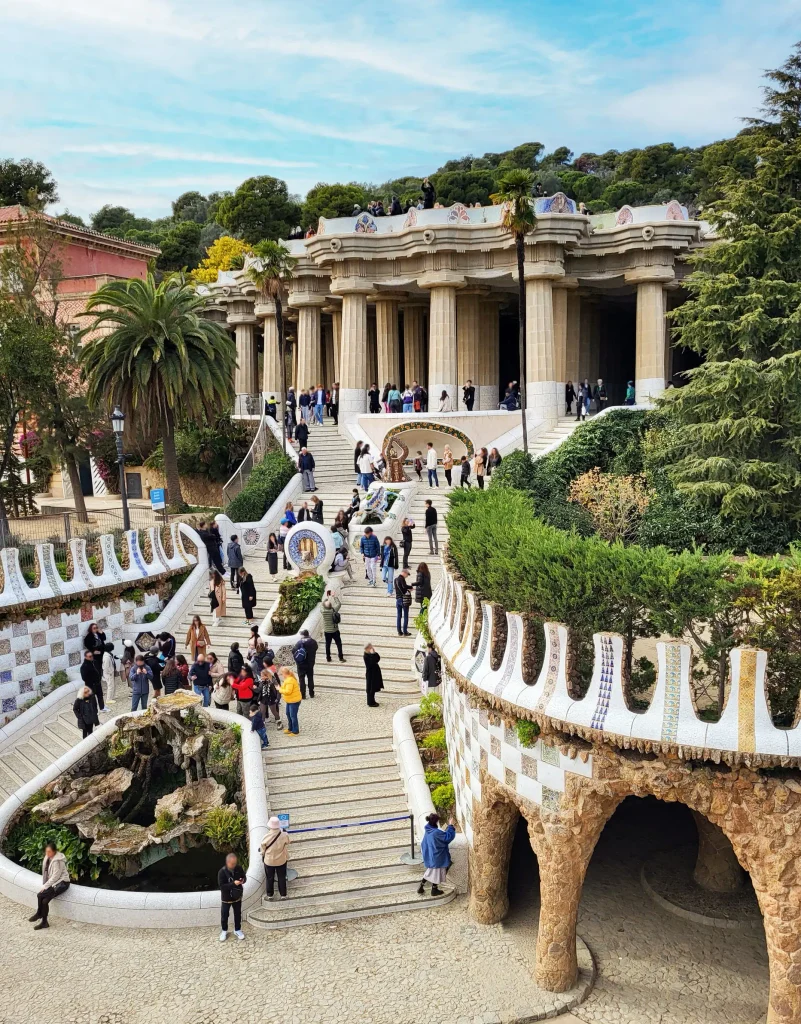
The Dragon Stairway is the natural starting point for exploring the central monumental area.
It is a double staircase arranged in three sections and decorated with fountains, stonework, sculptural forms and colorful ceramics. The official Park Güell material describes the monumental staircase as a three-section double staircase combining rocks and vegetation, with the famous dragon among its most recognizable features.
Instead of walking straight up, look at the individual elements as you climb.
You can see:
- Stone walls
- Decorative ceramics
- Fountain elements
- The Catalan coat of arms
- Animal-like forms
- The famous dragon or salamander
- The covered area beneath the Hypostyle Room
- The relationship between the staircase and the surrounding vegetation
The staircase is more interesting when you understand that it was not simply decorative. Water was incorporated into the design, connecting the staircase to the larger water-management system beneath the upper terrace.
3. See El Drac Without Making It the Whole Visit
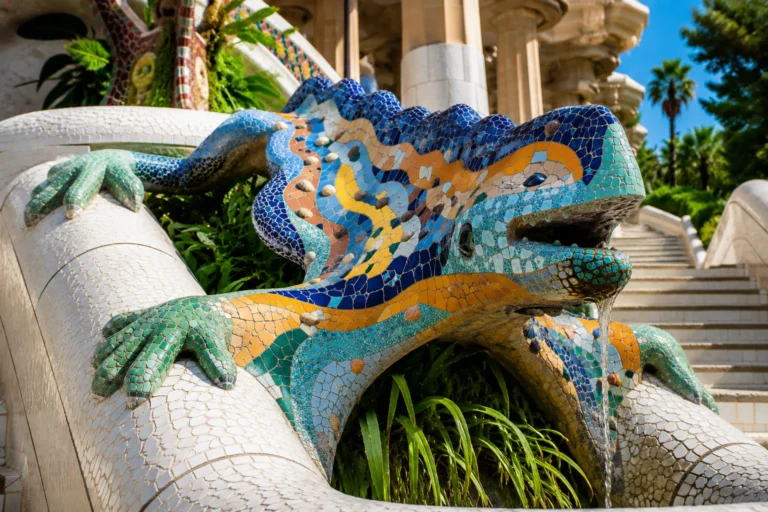
El Drac, the colorful mosaic salamander, is probably Park Güell’s most recognizable image.
It sits on the Dragon Stairway and is covered with small pieces of colored ceramic. The official Park Güell material describes the dragon as the park’s most popular image.
We have a separate article dedicated specifically to the Park Güell Lizard, so there is no need to repeat its entire history here.
For this article, the useful point is to look beyond the sculpture.
Notice how the dragon sits within the staircase composition rather than appearing as an isolated object. The surrounding fountains, stonework and stairs help create the experience.
If there is a queue or crowd around El Drac, remember that there is much more to see immediately beyond it.
4. Look at the Smaller Sculptural Details
The Dragon Stairway contains more than the famous salamander.
As you move upward, look for the smaller sculptural and decorative elements around the fountains and landings.
The staircase includes several forms that are easy to overlook when visitors concentrate only on El Drac.
Some details worth observing include:
- The fountain forms
- Animal-like sculptures
- Ceramic surfaces
- Stone textures
- The Catalan coat of arms
- The unusual shapes incorporated into the staircase
- The way water, sculpture and architecture are combined
Some visitors rush directly toward the dragon and miss the other forms built into the staircase.
This is one reason it is worth allowing a few extra minutes at the entrance rather than treating the staircase simply as a route to the top.
5. Enter the Hypostyle Room
Above the staircase is the Hypostyle Room, one of the most important architectural spaces in Park Güell.
It contains 86 fluted columns inspired by the Doric order. The space was originally designed to function as a covered market for the planned residential development.
This is an important distinction: Park Güell was not originally designed simply as a public park. Many of its spaces belonged to the infrastructure of the proposed residential development.
The columns are therefore not simply decorative objects. They supported the large terrace above and formed part of the original functional plan.
Look Up at the Ceiling
Do not spend your entire time looking at the columns.
The ceiling contains small domes decorated with tile-shard mosaics, including circular decorative panels associated with Josep Maria Jujol, one of Gaudí’s collaborators.
The official Park Güell flyer describes the roof as small domes using the Catalan vault technique and covered in trencadís.
The ceiling is one of the easiest details to miss because visitors naturally look toward the square and the city beyond.
Looking upward is one of the simplest but most rewarding things to do in Park Güell.
6. Understand Why the Columns Are Not All Straight
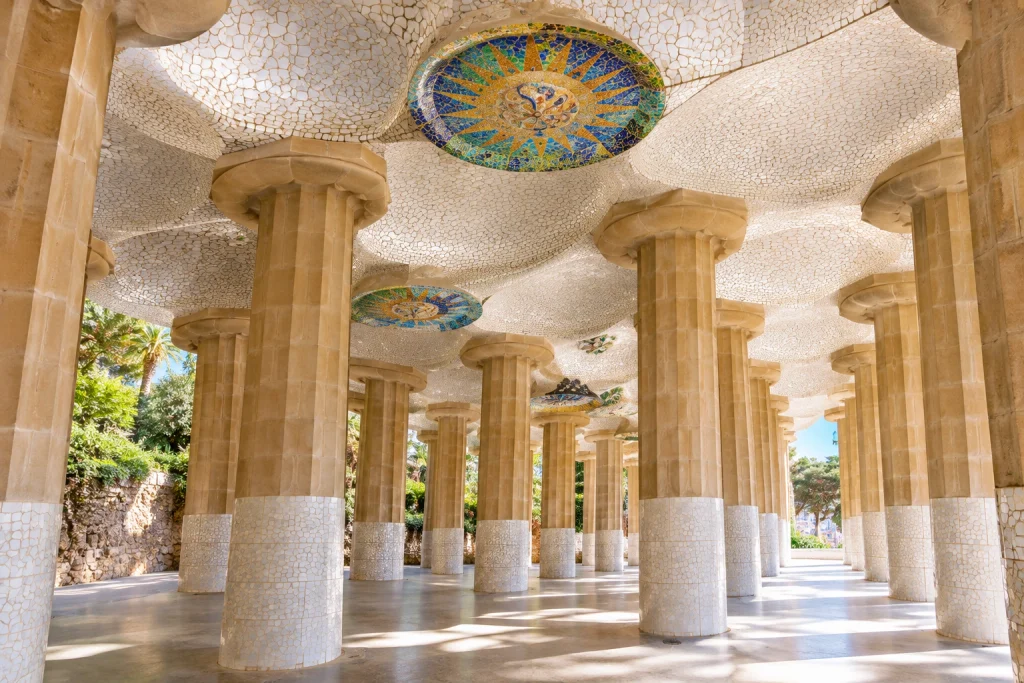
The columns of the Hypostyle Room are not simply a regular classical colonnade.
Some of the outer columns slope and move in an undulating arrangement rather than following a strict classical composition.
This gives the room a different visual character from a conventional columned hall and reinforces the connection between structural function and organic forms.
Instead of asking only “What is this?”, ask:
“Why did Gaudí make it this way?”
That approach makes the visit much more interesting and helps explain why the Hypostyle Room is one of the most important answers to what to do in Park Güell.
7. Notice the Rainwater System
One of the most useful details to understand in the Hypostyle Room is something that is almost invisible to visitors: the water-management system.
Rainwater falling onto the square above could be collected and directed toward an underground tank beneath the Hypostyle Room. The water system was connected to the fountain on the Dragon Stairway.
This means the famous dragon was not just a decorative sculpture.
The staircase, fountain, Hypostyle Room and Nature Square form part of a larger system.
The official information about the lower viaducts also describes systems for capturing and filtering rainwater into cisterns, showing how water management was integrated into the wider design.
This is one of the details worth understanding rather than simply photographing.
8. Step Into La Plaça de la Natura
After the Hypostyle Room, continue toward La Plaça de la Natura, also known as the Greek Theatre.
This large open space occupies the central part of Park Güell.
The original plans called it the Greek Theatre because it was intended for large open-air performances and events. The space was formed into the terrain, with part of it excavated into the rock and another part supported above the Hypostyle Room.
Today, it is one of the best places to pause during your visit.
The official Park Güell material describes the Greek Theatre/Nature Square as a space intended for outdoor shows and popular Catalan culture events.
For many travelers, reaching Nature Square is the central moment when deciding what to do in Park Güell.
9. Sit on the Serpentine Bench
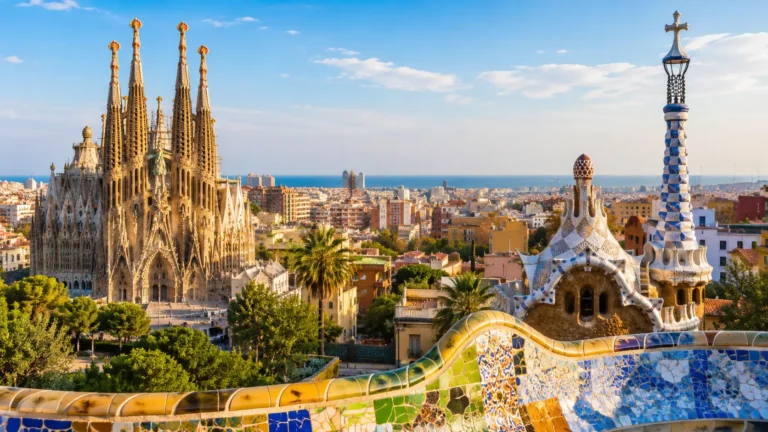
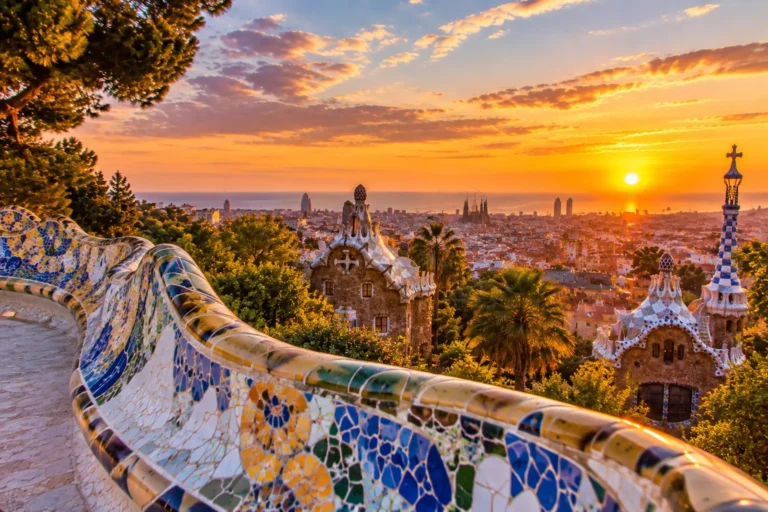
The long, curved serpentine bench is one of Park Güell’s defining features.
It surrounds the edge of Nature Square and combines seating with a decorative balustrade overlooking Barcelona.
The bench is covered with trencadís and was designed by Josep Maria Jujol. The official Park Güell material dates its construction to 1909–1914.
Look at the Bench From Both Sides
Do not only sit down for the view.
Walk along the bench and look closely at the mosaic surface.
The irregular ceramic pieces create different colors, shapes and textures. From a distance, the bench appears to be a continuous decorative surface; close up, its construction becomes much more apparent.
Look for:
- Different ceramic colors
- Irregular tile shapes
- Curves
- Decorative patterns
- The way the bench follows the terrace
- The view framed by the architecture
Walking along the bench is one of the best things to do in Park Güell if you want to appreciate the craftsmanship behind the famous photographs.
10. Look for the Drainage Details Around the Terrace
Nature Square is not simply a viewpoint.
Its relationship with the Hypostyle Room beneath it is one of the cleverest parts of the design.
Rainwater could filter through the square and be directed toward the underground tank below. The system helped make the landscaped upper area part of the practical infrastructure of the estate.
This is one of the reasons you should not think of the square, bench and Hypostyle Room as three unrelated attractions.
They are connected.
Once you understand this, the terrace becomes more than a place for photographs. It becomes an example of architecture, engineering and landscape working together.
11. Enjoy the Barcelona View
Once you reach Nature Square, take time to look outward.
The elevated position provides a broad view across Barcelona and is one of the reasons this part of Park Güell is so popular.
Instead of taking one photograph and leaving, look at how the city is framed by the curved bench and the architecture.
For photography, the square is especially useful because you can combine:
- Mosaic
- Architecture
- Trees
- Skyline
- Mediterranean light
- Gaudí’s curved forms
If you are wondering what to do in Park Güell after seeing the main structures, simply slowing down to enjoy the view is worthwhile.
12. Walk Through the Laundry Room Portico
The Laundry Room Portico, also called the Washerwoman’s Portico, is one of the more unusual spaces in Park Güell.
Its rough stone columns create a large wave-like form, and one of the columns incorporates a sculpted female figure representing a washerwoman carrying the tools of her trade.
The official Park Güell material similarly describes the portico as being made from unworked stone in the shape of a large wave, with a caryatid representing a washerwoman.
This area shows a different side of Gaudí’s architecture.
Instead of brightly colored mosaic dominating the space, the design relies heavily on rough stone, curves and the surrounding landscape.
Why Is It Worth Seeing?
The portico demonstrates how Gaudí could make a practical covered passage feel almost like part of the landscape.
Look at:
- The rough stone
- The inclined columns
- The wave-like form
- The washerwoman figure
- The relationship between the structure and hillside
For visitors asking what to do in Park Güell beyond the central square, this is one of the strongest choices.
13. Explore the Low, Middle and High Viaducts
The three main viaducts are among the most impressive examples of how Park Güell was designed around its difficult terrain.
They are known as:
- Low Viaduct — Pont de Baix
- Middle Viaduct — Pont del Mig
- High Viaduct — Pont de Dalt
Gaudí planned these routes to connect different areas of the proposed estate and help overcome the steep hillside. Their stone structures and sloping columns were integrated into the terrain.
The Low Viaduct
The Low Viaduct follows a curved route and uses inclined columns and stone construction.
Its design also incorporated rainwater collection and cisterns. The official description notes its two rows of inclined columns and central parabolic vault.
The Middle Viaduct
The Middle Viaduct is particularly interesting because its forms imitate natural caves while also performing a structural function as supports and retaining elements.
The official site specifically describes the viaducts as combining natural forms with structural functions such as buttresses and retaining walls.
The High Viaduct
The High Viaduct formed part of the higher road network through the estate.
Together, the three structures show that Park Güell was designed as more than a collection of decorative monuments.
Exploring them is an important part of what to do in Park Güell for anyone interested in architecture and engineering.
14. Look at the Roadways and Paths
The roads and paths are easy to ignore because visitors usually focus on the famous buildings.
That is a mistake.
Gaudí designed a network of routes that followed the landscape rather than forcing the terrain into a conventional grid.
The three viaducts formed part of a wider system connecting different areas of the planned estate. The official description also emphasizes the relationship between the road network, paths, viaducts and steep terrain.
Walking these paths helps you understand why Park Güell feels so integrated with its hillside setting.
It also gives you a quieter answer to what to do in Park Güell when the central attractions are crowded.
15. Explore the Austria Gardens
The Austria Gardens provide a greener contrast to the monumental area.
The land was originally intended for residential plots and was later used as a municipal plant nursery. The gardens received their current name after trees from Austria were donated and planted there in 1977.
If you have already photographed the main mosaic areas, this is a good place to slow down.
It also helps show that Park Güell is not only about colorful architecture.
Exploring the Austria Gardens is one of the best things to do in Park Güell if you want to see its landscape side.
16. See Larrard House and Trias House
Two residential buildings help tell the story of Park Güell’s original purpose.
Larrard House
Larrard House was the historic farmhouse of the former Can Muntaner de Dalt estate. It became part of the Park Güell project and remains an important historical element of the site.
Trias House
Trias House is particularly interesting because it was built on one of the very few plots of the planned development that were actually sold.
The official Park Güell visitor material identifies both Larrard House and Trias House among the site’s important points of interest. Their interiors are not open to visitors.
These buildings are useful reminders that Park Güell was originally planned as a residential development rather than as the public park visitors see today.
Important: Do not assume that every building listed as a Park Güell attraction is open for interior visits.
17. Visit the Gaudí House Museum
The Gaudí House Museum is another part of the Park Güell experience, but it should be treated differently from the outdoor architectural spaces.
The house was acquired by Gaudí’s father in 1906, and Antoni Gaudí lived there for a period. It is now a museum associated with the architect.
If you want to understand Gaudí beyond the monumental architecture, this can add useful context.
However, museum access has its own admission arrangements. Current Park Güell visitor material identifies access with a combined ticket.
If the museum is important to you, check the current admission conditions before planning your route.
Internal link: Gaudí House Museum guide
18. Walk the Palm Trees Path and Biodiversity Itinerary
Park Güell also contains less famous routes that are worth exploring if you have extra time.
The Palm Trees Path forms part of the park’s wider circulation network.
The Biodiversity Itinerary is another option for visitors interested in the natural side of Park Güell. The official site describes it as a 195-metre route near the Coll del Portell entrance, through woodland covering about one hectare.
These areas are useful if you want your visit to include more than architecture and photography.
You can also see how the park’s vegetation works with the stone structures instead of appearing as completely separate landscaping.
19. Climb Toward the Three Crosses
At the highest part of Park Güell is Turó de les Tres Creus, the Hill of the Three Crosses.
The official Park Güell information places it at approximately 182.30 metres above sea level.
The location provides another perspective over the surrounding landscape and gives visitors a reason to continue beyond the central monumental area.
Depending on current access arrangements, weather and route conditions, check which areas are accessible when you visit.
20. Look for Nature in the Architecture
Perhaps the most rewarding thing to do in Park Güell is to stop treating it as a collection of individual attractions.
Look at how Gaudí repeatedly connects architecture with nature.
You can see this through:
- Stone that follows the hillside
- Columns that resemble natural forms
- Viaducts built into the terrain
- Curved walls
- Organic shapes
- Vegetation integrated with structures
- Paths following the contours of the land
- Structures that work with rather than against the slope
The official Park Güell descriptions repeatedly emphasize the integration of architecture, roads, viaducts and the natural terrain.
This is the bigger idea behind many of the individual things you see at Park Güell.
Why Was Park Güell Designed This Way?
Understanding the original idea behind the site makes many of the attractions easier to understand.
Park Güell was conceived as a residential development rather than simply as a public park. The roads, viaducts, market, water system, gardens and houses were therefore connected to a larger plan.
That explains why features that might initially seem unrelated — such as the Hypostyle Room, viaducts and paths — actually work together.
It also explains why some residential buildings remain important to the story even though visitors cannot normally enter them.
This historical context does not need to become a separate history article. Instead, it helps explain why the things you see inside Park Güell were built in the way they were.
UNESCO and the Works of Antoni Gaudí
Park Güell is part of the UNESCO World Heritage property Works of Antoni Gaudí.
UNESCO lists seven properties within the serial World Heritage property, including Park Güell, Casa Milà, Casa Vicens, Casa Batlló and Gaudí’s work on the Sagrada Família. The property was inscribed in 1984, with the inscription later extended.
If you want to learn more about why Gaudí’s work has World Heritage status, you can read the UNESCO World Heritage listing for the Works of Antoni Gaudí.
What Should You See First in Park Güell?
If you have limited time, do not try to see everything equally.
Prioritize:
- Porter’s Lodge pavilions
- Dragon Stairway
- El Drac
- Hypostyle Room
- Nature Square
- Serpentine bench
- Barcelona viewpoint
- Laundry Room Portico
- Viaducts
- Austria Gardens
If you have more time, add the Gaudí House Museum, Biodiversity Itinerary, Palm Trees Path, Larrard House, Trias House and Three Crosses.
This order gives you a practical answer to what to do in Park Güell while still leaving room for the less crowded areas.
What to See in Park Güell in 30 Minutes
A short visit should concentrate on the central monumental sequence.
Route
Entrance → Dragon Stairway → El Drac → Hypostyle Room → Nature Square → Serpentine Bench → Viewpoint
Do not try to cover the entire park in half an hour.
Instead, focus on the areas that provide the strongest introduction to Gaudí’s architecture.
What to See in Park Güell in 1 Hour
With around an hour, you can add:
- Entrance pavilions
- Dragon Stairway
- Hypostyle Room
- Nature Square
- Serpentine bench
- Viewpoints
- Some surrounding paths
If walking conditions and access allow, continue toward one of the viaducts before leaving.
What to See in Park Güell in 2 Hours or More
With more time, slow down and explore beyond the central attractions.
A longer visit could include:
Entrance → Dragon Stairway → Hypostyle Room → Nature Square → Viaducts → Laundry Room Portico → Austria Gardens → Biodiversity Itinerary → Three Crosses
You can then decide whether the Gaudí House Museum fits your interests and ticket arrangements.
This longer route is ideal if you want a complete answer to what to do in Park Güell rather than seeing only the most photographed landmarks.
What Are the Most Interesting Details to Photograph?
If photography is important to you, look beyond the obvious dragon photograph.
Good subjects include:
- Trencadís mosaics
- Hypostyle Room ceiling
- Curved serpentine bench
- Stone viaducts
- Laundry Room Portico
- Entrance pavilions
- Barcelona skyline
- Organic stone forms
- Fountain details
- Architectural textures
- Contrasts between vegetation and architecture
- Views through arches and columns
The most interesting photographs often combine Gaudí’s structures with the surrounding landscape rather than isolating one decorative object.
What Do Visitors Often Miss in Park Güell?
The most famous areas naturally attract the largest crowds, but several details are easier to overlook.
Visitors often pay less attention to:
- The entrance pavilions
- The original gates
- The Hypostyle Room ceiling
- The water-management system
- The viaduct structure
- The Laundry Room Portico
- The relationship between the square and the cistern
- Austria Gardens
- Biodiversity areas
- Larrard House and Trias House
- The original residential purpose
- The way roads follow the hillside
- Smaller decorative details around the Dragon Stairway
These details can turn a short sightseeing stop into a much more interesting architectural visit.
What Is Worth Seeing If You Have Already Seen the Lizard?
If you have already visited the Dragon Stairway and photographed El Drac, do not assume you have seen the main attractions.
Continue to:
Hypostyle Room → Nature Square → Serpentine Bench → Viaducts → Laundry Room Portico → Austria Gardens
The viaducts and portico are especially useful if you want to see a different side of Gaudí’s work.
This is also why the dedicated Park Güell Lizard guide should complement rather than replace the wider Park Güell visit.
A Better Way to Experience Park Güell
Rather than asking only “What should I photograph?”, ask three questions as you walk through the park:
What Was This Space Designed to Do?
The Hypostyle Room was intended as a market, while the roads and viaducts were designed to connect the planned development.
How Does It Interact With the Landscape?
The viaducts, paths and stone structures were designed around the hillside rather than treating the terrain as an obstacle.
How Do the Individual Features Connect?
The Dragon Stairway, Hypostyle Room, Nature Square and water system are not isolated attractions. They form a connected architectural sequence.
Understanding these relationships gives you much more from the visit than simply checking off famous landmarks.
Guided Tour or Self-Guided Visit?
A self-guided visit works well if you want to move at your own pace and concentrate on photography or particular architectural details.
A guided tour can be useful if you want more explanation about the history, symbolism, Modernisme and the relationship between Gaudí’s architecture and nature.
The official Park Güell site currently offers guided tours in several languages. It describes the guided itinerary as approximately one hour and says the groups have a maximum of 25 people.
For a first visit, a self-guided route can be enough if you prepare beforehand. A guided visit may be more useful if architectural history is one of your main interests.
Park Güell App and Visitor Information
If you want to explore the park independently, official digital visitor resources can also be useful for understanding the layout, attractions and routes.
Before visiting, check the official Park Güell information for current access arrangements, maps, visitor services and any temporary restrictions.
This is particularly important because access conditions can change and not every part of the park has the same visitor rules.
For visitors interested in accessibility, Barcelona City Council provides a dedicated Park Güell – Visita inclusiva resource. You can open the page or scan the QR code to access the app on your mobile device.
Useful resource: Barcelona City Council – Park Güell Visita Inclusiva
Other municipal apps: Barcelona City Council Municipal Apps
Is Park Güell Suitable for Families?
Park Güell can be interesting for families because it combines unusual architecture, colorful mosaics, open spaces and views.
Children may particularly enjoy:
- El Drac
- The Dragon Stairway
- The unusual shapes and sculptures
- Mosaic patterns
- The viaducts
- Nature and vegetation
- The panoramic views
However, remember that the park includes slopes, stairs and uneven routes.
For younger children, allow extra time rather than trying to complete the whole park quickly.
Facilities and Practical Details
A longer visit is easier if you plan around basic practical needs.
Depending on your route and current visitor arrangements, look for:
- Toilets
- Rest areas
- Water/fountains
- Visitor information
- Designated routes
- Transport connections
- Exit points
Do not assume that every facility is immediately beside the Monumental Zone.
The official Park Güell visitor material includes visitor-service information and identifies facilities such as toilets, rest areas, fountains and transport-related points on its accessibility material.
Accessibility at Park Güell
Park Güell’s hillside location means that accessibility varies considerably between different areas.
Some routes contain:
- Slopes
- Stairs
- Uneven surfaces
- Steep sections
- Narrower paths
The official Park Güell site provides specific accessibility information and recommended routes.
If reduced mobility is an important consideration, check the current official accessibility route before your visit rather than assuming that the entire park can be explored in the same way.
Do You Need a Ticket to See the Main Attractions?
Access arrangements vary between the different parts of Park Güell.
The monumental tourist area has controlled access, while other areas have different conditions. Current visitor information also identifies some spaces as not open internally and the Gaudí House Museum as requiring combined-ticket access.
If your priority is seeing the famous monumental features such as the Dragon Stairway, Hypostyle Room and Nature Square, check the current Park Güell ticket information and entry arrangements before travelling.
How Long Should You Spend in Park Güell?
There is no single ideal duration.
A short visit can focus on the central monumental area, while a longer visit allows you to understand the wider landscape and architectural system.
Around 30 Minutes
Focus on the central highlights.
Around 1 Hour
Explore the main monumental area without rushing.
Around 2 Hours
Add viaducts, gardens and additional architectural features.
Longer Visit
Consider the wider paths, Biodiversity Itinerary, Three Crosses and Gaudí House Museum according to current access arrangements.
The important thing is to avoid creating such a tight schedule that you spend the entire visit watching the clock.
How to Get to Park Güell
Park Güell is located on a hillside, so the route you choose can affect how much walking you need to do.
You can reach the area by public transport, taxi or car, with different entrances and walking routes depending on your starting point.
Because transport routes, accessibility arrangements and visitor access can change, check your route before travelling.
For a detailed guide, see How to Get to Park Güell by Metro, Bus, Taxi or Car.
Park Güell Rules and Visitor Tips
A few simple habits can make the visit easier.
- Arrive with enough time for your entry.
- Wear comfortable shoes.
- Expect slopes and stairs.
- Bring water, especially in warm weather.
- Look up as well as forward.
- Do not climb heritage structures.
- Keep your ticket accessible.
- Do not assume you can re-enter after leaving.
- Follow current access instructions.
- Check current visitor rules before travelling.
The exact access and visitor regulations can change, so use current official information when planning your visit.
Is Park Güell Worth Visiting?
For visitors interested in Gaudí, architecture, mosaics, gardens or Barcelona’s viewpoints, Park Güell offers much more than the famous lizard photograph.
The strongest reason to visit is the combination of:
- Architecture
- Engineering
- Landscape
- Mosaic
- Water management
- Vegetation
- Hillside views
- Historic residential planning
If you only have a short time in Barcelona, concentrate on the central monumental area. If you have more time, continue into the viaducts, gardens and quieter paths.
What to Do Near Park Güell
Park Güell can easily be combined with other Barcelona attractions.
One popular option is to combine it with the Sagrada Família, especially if you want to see two major Gaudí sites during the same day.
You can also consider:
- Gràcia
- Casa Batlló
- Casa Milà
- Other Gaudí architecture
- Barcelona viewpoints
- Local restaurants and cafés
For a more detailed route between major attractions, use your dedicated Sagrada Família to Park Güell guide.
Park Güell Visitor Checklist
Before leaving for Park Güell, make sure you have:
- Your ticket or booking information
- Comfortable walking shoes
- Water
- Sun protection when needed
- Enough time for the route you want to follow
- Your phone or camera
- A transport plan for after your visit
- Current access information
If you have only 30 minutes, concentrate on the central sequence.
If you have one hour, add the surrounding paths and viewpoint.
If you have two hours or more, explore the viaducts, Laundry Room Portico, Austria Gardens, Biodiversity Itinerary and Three Crosses where accessible.
Final Tips for What to Do in Park Güell
Wear comfortable shoes because Park Güell includes slopes, stairs and uneven walking routes.
Look up as well as forward. Some of the best details are on ceilings and elevated structures.
Do not spend your entire visit around El Drac. The dragon is famous, but the Hypostyle Room, Nature Square, viaducts and Laundry Room Portico reveal much more about Gaudí’s approach.
If you are interested in architecture, pay attention to how structures solve practical problems rather than only how they look.
Look at the park as one connected environment rather than a collection of separate attractions.
And if you want to see the regulated monumental attractions, check your Park Güell ticket and entry arrangements before building the rest of your Barcelona itinerary.
Frequently Asked Questions
What are the best things to do in Park Güell?
The best things to do in Park Güell include walking the Dragon Stairway, seeing El Drac, exploring the Hypostyle Room, visiting Nature Square, sitting on the serpentine bench and exploring the viaducts, gardens and viewpoints.
What should I see first when deciding what to do in Park Güell?
If you are deciding what to do in Park Güell with limited time, start at the main entrance and follow the Dragon Stairway to El Drac, the Hypostyle Room, Nature Square and the serpentine bench. You can then continue toward the viewpoints and viaducts.
What is the most famous thing to do in Park Güell?
Seeing El Drac, the famous mosaic salamander on the Dragon Stairway, is one of the most popular things to do in Park Güell. However, the park has many other important architectural features worth exploring.
What is the Hypostyle Room used for?
The Hypostyle Room was originally designed as a covered market for the planned residential development. It contains 86 fluted columns and a decorated ceiling, making it one of the most important things to see when exploring what to do in Park Güell.
What is Nature Square in Park Güell?
Nature Square, originally called the Greek Theatre, is the large open space above the Hypostyle Room. It was planned for open-air performances and is surrounded by the famous serpentine bench. Visiting Nature Square is one of the main things to do in Park Güell.
Are the Park Güell viaducts worth seeing?
Yes. The Low, Middle and High Viaducts show how Gaudí adapted roads and supporting structures to the steep terrain. Exploring the viaducts is an important part of what to do in Park Güell if you are interested in architecture and engineering.
Can you visit the Gaudí House Museum?
Yes, but it has separate admission arrangements. Current Park Güell visitor information identifies access through a combined ticket, so check the current conditions before visiting. The museum can be included in your plans when deciding what to do in Park Güell.
Can you see Larrard House and Trias House inside?
Their interiors are not generally open to visitors. They are nevertheless important parts of Park Güell’s architectural and residential history and are worth seeing from outside when exploring what to do in Park Güell.
How much time do you need for what to do in Park Güell?
A focused visit can cover the main monumental area in around 30 minutes to an hour. Allow around two hours or more if you want to explore the viaducts, gardens, paths, Three Crosses and additional architectural features.
Is Park Güell only about Gaudí’s mosaics?
No. What to do in Park Güell goes far beyond looking at mosaics. The park combines architecture, structural engineering, landscaping, water management, roads, stonework, vegetation and views across Barcelona.
Can I visit Park Güell without seeing the whole park?
Yes. If you have limited time, focus on the central monumental area. If you have more time, continue into the wider park to explore the viaducts, gardens, paths and viewpoints. This lets you adapt what to do in Park Güell to the time available.
What should I not miss when visiting Park Güell?
Do not miss the Dragon Stairway, El Drac, Hypostyle Room, Nature Square and serpentine bench. If you have more time, add the Laundry Room Portico, viaducts, Austria Gardens and Three Crosses to your list of things to do in Park Güell.
What is the Park Güell lizard?
The Park Güell lizard is the famous mosaic salamander located on the Dragon Stairway. It is one of the park’s best-known symbols and one of the most photographed things to see in Park Güell.
What is the Park Güell dragon?
The Park Güell dragon is the colorful mosaic salamander on the entrance staircase. It is also commonly called the Park Güell lizard or El Drac and is one of the most recognizable things to do in Park Güell.
How long should I spend at Park Güell?
The amount of time depends on how deeply you want to explore. A short visit can concentrate on the main Monumental Zone, while a longer visit allows time for the viaducts, gardens, Three Crosses, museum and natural areas. Your available time should determine what to do in Park Güell.
Can you visit Park Güell without a ticket?
Some areas of the wider park have different access arrangements, while the regulated tourist area has controlled access. Check the current official rules before visiting the areas you want to include in what to do in Park Güell.
Can I buy Park Güell tickets at the entrance?
Ticket availability and sales conditions can change. Checking availability in advance is recommended, particularly if you want a specific entry time for the things to do in Park Güell that require access to the regulated area.
Can I see Barcelona from Park Güell?
Yes. Nature Square and the Three Crosses area provide elevated views over Barcelona. Enjoying these viewpoints is one of the most rewarding things to do in Park Güell, particularly if you want photographs of the city.
Is Park Güell good for photography?
Yes. The Dragon Stairway, mosaics, serpentine bench, viaducts, architecture, vegetation and Barcelona views provide many opportunities for photography and are among the most popular things to do in Park Güell.
Can I visit Park Güell at night?
Tourist access depends on the current seasonal schedule and access rules. Do not assume that the Monumental Zone is open for tourist visits throughout the night. Check the current conditions before planning what to do in Park Güell after dark.
What should I wear to Park Güell?
Wear comfortable shoes because the park contains slopes, stairs and uneven paths. In warm weather, lightweight clothing and sun protection are also useful when exploring the different things to do in Park Güell.
Is the Gaudí House Museum inside Park Güell?
The Gaudí House Museum is located within the Park Güell complex and is associated with Gaudí’s life. Check current admission arrangements before including it in your plans for what to do in Park Güell.
Is Park Güell suitable for people with reduced mobility?
Some areas can be difficult because of stairs, slopes and uneven paths. The official site provides specific recommended routes and accessibility information. Check these routes before deciding what to do in Park Güell if accessibility is important for your visit.
What are some things to do in Park Güell besides seeing the lizard?
After seeing El Drac, continue to the Hypostyle Room, Nature Square, serpentine bench, Laundry Room Portico, viaducts and Austria Gardens. These areas show why what to do in Park Güell should not be limited to the famous lizard.
What can you do in Park Güell if you have only 30 minutes?
Follow a simple route from the entrance to the Dragon Stairway, El Drac, Hypostyle Room, Nature Square, serpentine bench and viewpoint. This gives you a compact introduction to what to do in Park Güell.
What can you do in Park Güell in two hours?
With around two hours, you can explore the central monumental area and continue toward the viaducts, Laundry Room Portico, Austria Gardens, Biodiversity Itinerary and Three Crosses, depending on current access and walking conditions.
What do visitors often miss in Park Güell?
Visitors often overlook the Hypostyle Room ceiling, water-management system, entrance pavilions, Laundry Room Portico, viaducts, Austria Gardens, Biodiversity areas and the relationship between the architecture and hillside. These details add depth to what to do in Park Güell.
Is Park Güell worth visiting?
Park Güell offers much more than the famous lizard, combining Gaudí’s architecture with engineering, gardens, water systems, natural terrain and views over Barcelona. The variety of things to do in Park Güell makes it possible to create either a short or a longer visit.
Final Thoughts
The best way to experience Park Güell is to look beyond the famous photograph.
Start with the Dragon Stairway and El Drac, but then continue into the Hypostyle Room, Nature Square and the serpentine bench. From there, explore the viaducts, Laundry Room Portico, Austria Gardens and the wider paths if you have enough time.
What makes the park special is not simply the number of attractions. It is the way Gaudí connected architecture, engineering, water, vegetation and the natural hillside into one environment.
That is why, when deciding what to do in Park Güell, you should leave some time to slow down and notice the details that are easy to walk past.
If you are planning your visit, check your Park Güell tickets and available entry information before arranging the rest of your Barcelona itinerary.
For more information about Antoni Gaudí’s architectural heritage and its UNESCO recognition, see the UNESCO World Heritage listing for the Works of Antoni Gaudí.
Plan Your Visit to Park Güell
Check tickets, prices and available experiences before you visit.
View Tickets